

Breaking the Loop at its Source
By getting the "loop" driving our self-destructive behaviors clearly visualized, we can get serious about breaking it. That’s the only way to make behavioral change stick long-term.

Sometimes, when we’re struggling to change a behavior that we know is self- destructive—from binge-eating and drinking to procrastination and doomscrolling—it can feel like we’re trapped in an unbreakable cycle. Even if we manage to brute-force stop the behavior for a bit, something may push us back into it. This doesn’t mean we’re fundamentally broken and unable to change. Often, it just means that we haven’t found and addressed the root cause of the behavior—we’re trying to bail out water without repairing the leak.
In his insightful book The Therapy Manifesto: A Principled Guide to Developing Your Mental Health, psychologist Mark Derian identifies three key stages in identifying and dealing with unhealthy emotions and behaviors by identifying their root causes:
Honesty
The Loop
Ritual
In short, honesty refers to the process of identifying and facing what you’re feeling. That may sound straightforward, but we are often unaware of or actively evading the true nature of our emotions. For example, I only recently developed the ability to identify when I’m depressed (which, it took me a while to understand, is not a state of intense sadness so much as one as of passive demotivation and hopelessness). I had previously mistaken actual depression for a purely physical low-energy state. I also often experienced anxiety or frustration without really being aware of it—my awareness was directed at external situations, not my own feelings.
Since I started undergoing therapy (which Derian defines to include both talking through feelings with others and processing them internally) last summer, I have written here extensively about my thought processes. Virtually all of that work falls under the “honesty” stage of Derian’s process—getting clear on my thoughts and feelings. I wrote recently about the fact that I am switching from a psychodynamic therapist to a Cognitive Behavioral Therapy (CBT) one, because I am now finding myself retreading familiar ground when introspecting about the historical causes of my emotions and I need to change the self-destructive habits and behaviors in my life that, regardless of how well I understand their causes, still persist as habituated patterns in my psychology. Derian observes that neither of these approaches is useful without the other—rehabituation doesn’t work without understanding the cause of a habit, and understanding the cause is academic until we do something with that knowledge.
Astute readers may notice from this that I very nearly jumped right over Derian’s middle step: the loop. CBT is essentially what Derian calls “ritual”: habituating the right behaviors through psychological self-conditioning and practical strategies. My approach of jumping from psychodynamic (honesty) to CBT (ritual) wouldn’t have worked because I was missing the bridge that integrates them. Derian defines the loop as “your unconscious emotional adaptation that creates your symptoms.” It’s a habituated cycle of feelings, behaviors, and premises that self-reinforces every time you go round it. Somewhere along that loop is the point where the fundamental cause of your self-destructive feelings and behaviors started it, and identifying that cause requires knowing the complete loop.
Fortunately, in the course of preparing for an assessment to match me with a CBT therapist, I identified my loop almost by accident. My main goal in the CBT process is to get a handle on the anxiety and anger I feel about various things I can’t (or don’t believe I can) control. Examples include everything from the state of the world to the personal relationships that haven’t gone the way I wanted. The emotions can feel equally as strong whether they’re about such consequential things as the threat of war in Europe or such trivial things as being stuck at a red traffic light. That immediately told me that the cause isn’t any of these particular things—it’s an underlying sense of not being in control. Then I asked myself: Where did that start? I thought back to all the moments in my early life where I didn’t feel in control, and that helped me to identify the common factor: I never felt efficacious as a child because I could not get other people to understand me. I couldn’t socialize with or relate to most people, and so, with all but a few people, I couldn’t make my feelings understood, express my ideas, build healthy relationships, or make any real impact in the world around me. Quickly, I unconsciously created a package deal: I combined together things that are not normally under any person’s control (e.g. the state of the world) with things that other people can do but I couldn’t (e.g. understanding and participating in normal social dynamics). In general, I felt like my life was out of my control.
Once I’d found that root cause, I could see my loop. It looks like this:
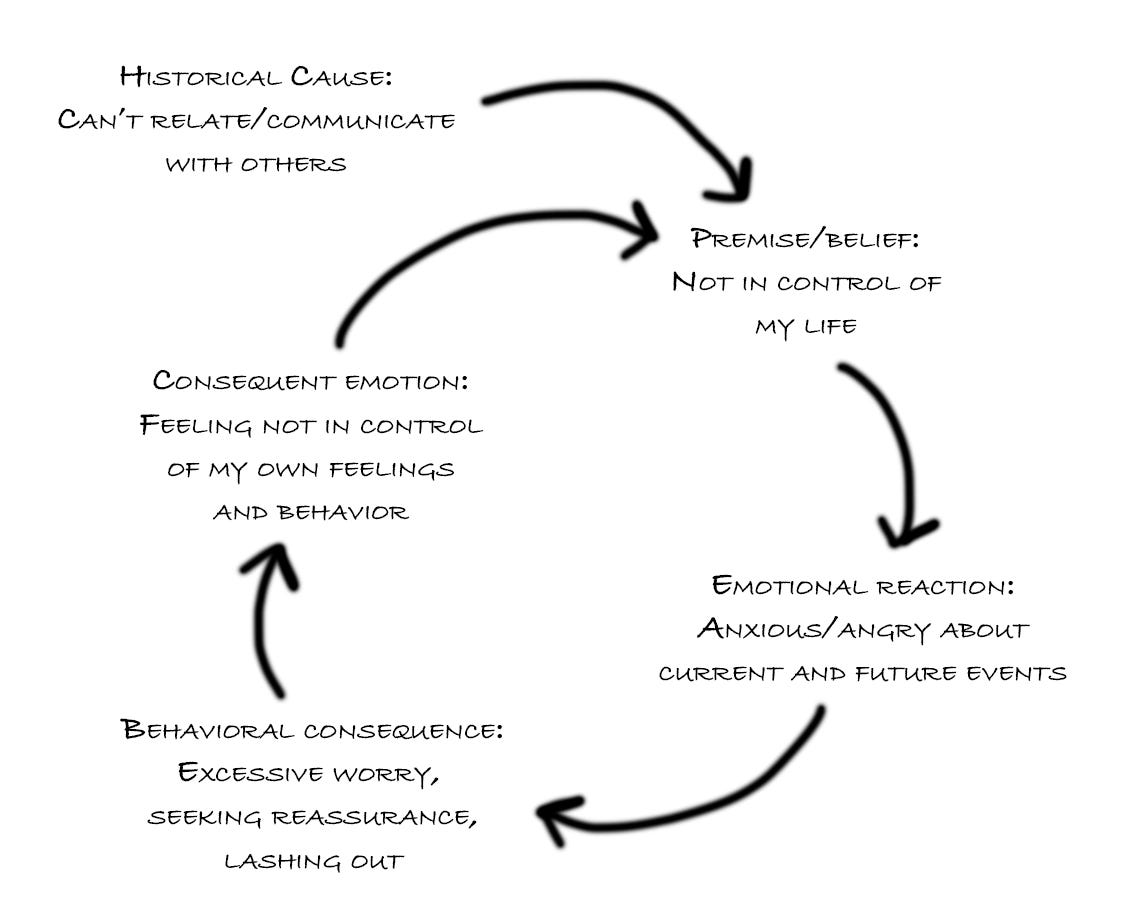
You can see how the fact that the historical cause has become less relevant—I’ve grown and changed the people I spend time with enough that I don’t have that problem to anything like the same degree today—doesn’t change the loop because it’s already become self-reinforcing. I’ve had a fair amount of success in brute-force disciplining myself to break the loop at the behavioral stage—for example, breathing deeply when I catch myself getting anxious or angry about something—and that has helped improve my quality of life, relationships, and my productivity at work. But that doesn’t stop the cycle from continuing back round because the energy driving the circuit starts where the original cause plugs in: at the premise.
Now that I have my loop clearly visualized in front of me, I can get serious about breaking it. That’s the only way to make behavioral change stick long-term. For me, that means challenging my anxiety about control at the source: building belief in my own efficacy. That means giving myself evidence that I can and do control my own actions, act morally, and produce value while accepting that there are things I properly cannot control (e.g. how others feel or the state of the world at large).
If you have self-destructive behaviors you want to get under control, I cannot encourage you enough to follow Derian’s steps: Get fully in touch and familiar with what you’re feeling, identify the loop that’s driving those feelings and the behaviors that follow from them, and find the part of the loop where the circuit starts. Then you can pull the battery out and shut the system down. I’ll write more about that process as I go through it in the coming months.