

The Happiness Triangle
Tai Lopez's formulation that the "good life" consists of "health, wealth, love, and happiness" forms, with a few tweaks, a valuable framework for prioritizing our time.

Since I first discovered the self-help movement twelve years ago, I’ve appreciated Tai Lopez’s formulation that achieving “the good life” is only possible if we consistently maintain four things: “health, wealth, love, and happiness.”
He regards these four things as interdependent—we can’t consistently or fully enjoy the benefits of any of them unless we have all four. Being wealthy isn’t much use without good health, and even a healthy and wealthy life wouldn’t be great for most people without the company of those we love.
When we experience personal crises, it’s easy to let our focus on these priorities slip, and that’s definitely happened to me over the past year. I focused on the areas that most needed work in my life—love and mental health—and dropped the ball to some extent on wealth and physical health. As much as I’ve succeeded in the first two areas in that time—I’ve made huge strides in improving my mental health and personal relationships—my happiness and ability to focus on what matters are constantly undermined by the fact that my physical health and financial wellbeing are not as good as they’ve been in the past, demonstrating Lopez’s point.
Recently, while walking on a Florida beach and reflecting on my past year, I began thinking again about Lopez’s formulation and came to a realization: Happiness doesn’t belong on his list. Rather, properly understood as a state of active joy in living as a human being, it is “the good life,” the goal that the other three items are essential to.
Suddenly, what had been a flat list of four priorities became a triangle in my mind, with health, wealth, and love on the corners all integrating to form happiness in the center.
The next thing I realized is that the three outside terms need some explanation to be interpreted correctly. (Lopez does this, but I needed to define them in certain ways for my own purposes.)
The key elements for me were that:
“Health” includes mental health, which not only means looking after psychological issues but also setting aside appropriate rest and relaxation time and pursuing one’s hobbies.
“Wealth” includes spiritual wealth, which includes the pursuit of purpose and meaning through productive work.
“Love” includes friendship and family alongside romantic relationships.
The overlap and interdependency between these is apparent once we get this granular. For example, mental health is going to help and be helped by spiritual wealth. Likewise, friendships and romance should contribute to spiritual wealth.
Once I’d arrived at these expanded definitions, I had created a diagram that provided clear direction for how I need to live my life going forward:
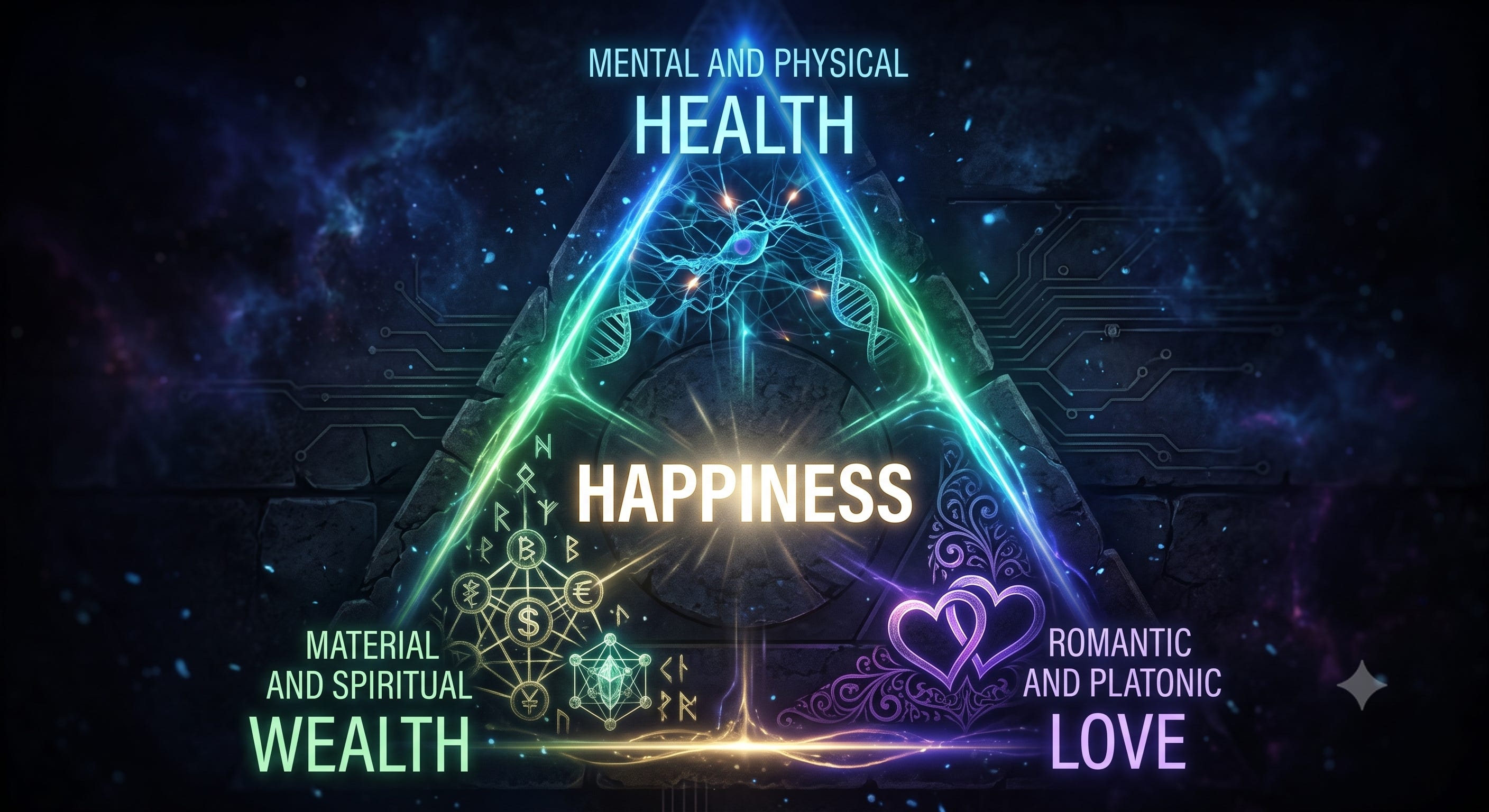
Lopez is a voracious reader, including of Greek philosophy, and Aristotle’s Nicomachean Ethics was the book that kick-started his self-development journey and career. In that work, Aristotle observes that achieving eudaimonia—a state of active happiness through the continuing embodiment of virtue and achievement of purpose—requires “goods of the body,” “goods of the soul,” and “external goods.” These almost directly map onto “health,” “love,” and “wealth” respectively. Perhaps Lopez put “happiness” last in recognition of the fact that the other three are prerequisites for it and that it is the ultimate goal, but Aristotle more precisely observed that happiness is fundamental—the other three get their importance from that goal.
I’m now engaged in identifying specific lifestyle changes I need to make to properly prioritize all three elements of the triangle. Here are just some of the ones I’ve listed so far:
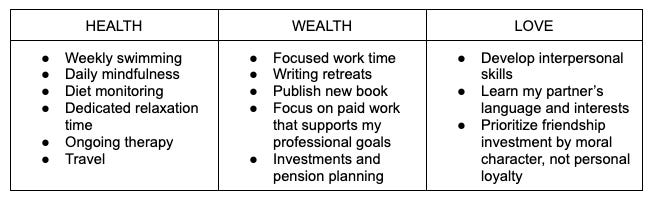
The particular changes and goals you may need to implement will depend on your current situation. The purpose of the triangle is to help you identify which of the three broad categories you are potentially under-investing in, and whether the things you’re currently spending your time on are or are not advancing each of the three priorities. As a next step, I recommend writing out three lists:
Your current regular time-consuming activities, identifying which of the three priorities they help and/or hinder
Which particular aspects of the three priorities you’re currently struggling with (e.g. physical or mental health or a particular aspect of these such as cardio or emotional regulation)
What specific changes, such as those I listed above, will help you address these struggles without hindering the other priorities
I hope the triangle will help you think about your future priorities as it has for me. It won’t be enough on its own—you need to identify your core productive purpose as well, as I’ve written about before. For me, that’s writing and producing content about science fiction, space travel, and the values of reason and curiosity. You can have other productive purposes as well (as writing about self-development is for me), provided those integrate with the core productive purpose. Underneath all of this is the ultimate purpose of your own happiness and flourishing. The function of the triangle is not to give you purpose, but rather focus your mind on the priorities that will help you achieve it.
If you value reason, curiosity, and ideas for a flourishing future, please consider subscribing to my other Substack, Trekker Tom.